

Klarna
Redesigning Limit Transparency, Instant Remediation & Purchase Simulation on Klarna


Role: Senior Product Designer (Independent Concept)
Timeline: 2 Weeks
Domain: Fintech / Buy Now, Pay Later (BNPL)
Focus: Transparent Risk Communication & Frictionless Checkout


About
Klarna is a global Buy Now, Pay Later (BNPL) and payments fintech platform that allows millions of shoppers to split purchases into flexible installment plans. A central feature of its app is Purchasing Power which is an estimated spending cap meant to guide users on their available credit. This case study addresses a critical UX breakdown in the Klarna app: silent, unnotified reductions in Purchasing Power that lead to unexpected checkout declines and user frustration. By balancing user trust with merchant conversion goals, this project introduces a Trust Restoration System by replacing passive limit drops with dynamic delta animations, direct root-cause remediation, and an on-demand pre-checkout simulator.
Executive Summary
Klarna’s Purchasing Power feature provides users with an estimated spending limit, but unnotified reductions lead to unexpected checkout declines and user frustration. This case study transforms passive credit drops into an active Trust Restoration System that delivers clear risk communication without hurting merchant conversion. The solution uses dynamic home screen animations to highlight exact limit drops like -£500 in Purchase Power, a diagnostic breakdown page that links reductions directly to root causes like missed payments with a one-tap recovery path, and an on-demand pre-checkout simulator that lets users test purchase amounts to unlock custom down-payment options while saving backend API costs.
The Problem: The Silent Degradation Loop
Klarna’s Purchasing Power indicator is meant to act as a clear spending compass, but dynamic risk adjustments like missed installments or credit sweeps that cause spending limits to drop continuously behind the scenes. The core issue isn't that limits drop, but how the app communicates those drops:
-
Silent Updates: Drops occur without push notifications or visual cues. Users open the app to a raw, updated number (e.g., £300) with zero context on what it used to be.
-
No Loss Visibility: The app conceals the reduction amount (-£500), leaving users unable to connect the drop to a specific cause, such as a bounced £15 payment.
-
Unexpected Checkout Declines: Because Purchasing Power is an estimate, users enter checkout confident in their limit, only to face abrupt rejections at payment that are sparking widespread frustration across Reddit, YouTube, and app reviews.
-
Business & System Constraints: Klarna cannot place aggressive, punitive banners on the Home feed without hurting merchant sales, nor can it constantly recalculate dynamic cart limits for millions of passive users without overwhelming backend APIs.

Existing screens from the live Klarna app (UK)
The Solution
To bridge the gap between static user expectations and dynamic backend underwriting, the redesigned experience transforms Purchasing Power from a passive estimate into an active Trust Restoration System.
The solution addresses silent drops through three core touchpoints:
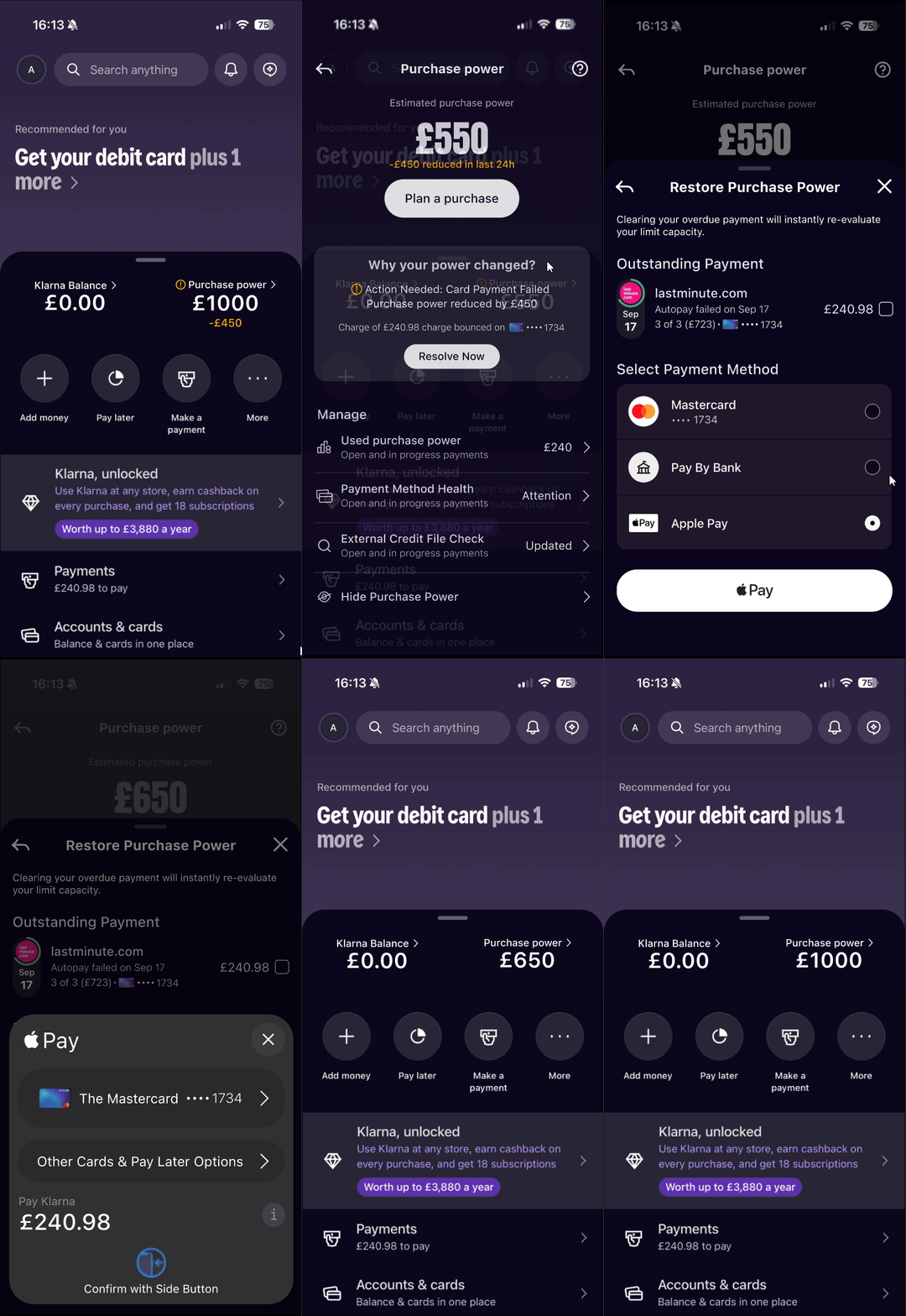
1. Home Screen Delta Animation: Upon opening the app, a negative delta badge (e.g.-£450) animates next to the updated Purchasing Power limit before tallies down. This gives immediate visual context without disrupting the main browsing feed or hurting merchant conversion.
2. Diagnostic Hub & One-Tap Recovery: Tapping the Purchasing Power card opens a dedicated breakdown displaying the exact date, total loss, and root cause (e.g. a missed £240.98 payment on a specific card). A prominent Recover Now CTA routes directly to debt clearance, clearly stating that settling the balance will replenish spending power.

5. User's purchase power restores to their original limit
1. App entry animates the exact drop with a -£450 badge.
2. Displays the drop reason (e.g., missed £240.98 payment) and a Recover Now CTA to fix it instantly.
3. Confirms clearing the £240.98 payment will restore Purchasing Power immediately.
4. Returning home triggers a green +£450 badge and a fast tick-up animation back to full limit.
3. Pre-Checkout Simulator: An on-demand sandbox button (Plan a Purchase) where users can input an intended cart amount. The engine executes a single underwriting check to show real-time approval odds and flexible down-payment terms (£250 today + 3 installments) before the user reaches checkout, eliminating cart anxiety while saving continuous API calls.

5. Prevents checkout anxiety by letting users verify purchase approvals in advance.
2. Plan a purchase screen has a checkout simulator that lets the user test a big amount to see if klarna will approve it or not
3. User clicks on verify and the app does its calculation to show an updated limit
4. Once user gets confirmation for the new limit purchase they can shop with confidence
1. User wants to check if they can purchase a big amount item after their reduced purchase power
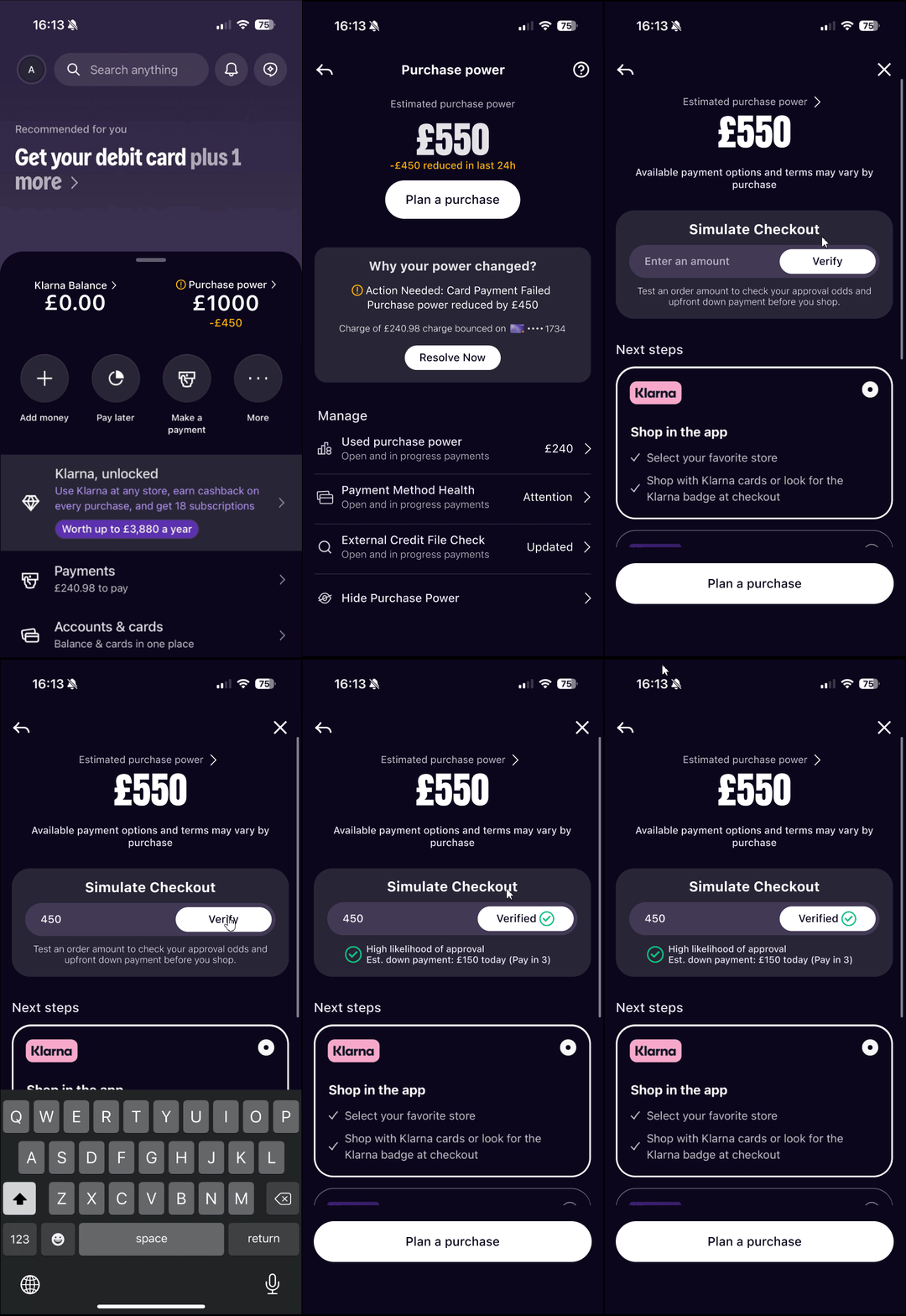

Different states for the Checkout simulator based on the amount user has added and how much they own Klarna or their credit score
End to end gif animation to showcase how the screenflow would work across both the feature improvements
Measuring Overall Product Success
To evaluate the impact of the Trust Restoration System, success is tracked across debt recovery efficiency, operational efficiency, checkout performance, and user engagement:
-
24-Hour Debt Resolution Rate: Measures the percentage of micro-debts (e.g., £15 overdue) settled immediately after a Purchasing Power drop. A higher rate accelerates capital recovery and reduces bad-debt write-offs.
-
Support Ticket Deflection: Tracks the reduction in customer inquiries regarding unexplained limit decreases, directly cutting operational and support costs.
-
Checkout Approval Rate: Monitors cart conversion at merchant checkouts. Preventing unexpected limit declines preserves Gross Merchandise Value (GMV) and protects merchant relationships.
-
Simulator Adoption Rate: Tracks how frequently users launch the Plan a Purchase sandbox before high-value transactions, proving a reduction in user checkout anxiety.
Conclusion
The Trust Restoration System replaces opaque risk updates with immediate, transparent feedback. By framing limit drops around clear root causes and providing a direct path to resolution, the experience turns financial friction into instant debt recovery while preserving merchant conversion, reducing support overhead, and maintaining long-term user trust.